← Back to Knowledge Base
business and technology5 min read

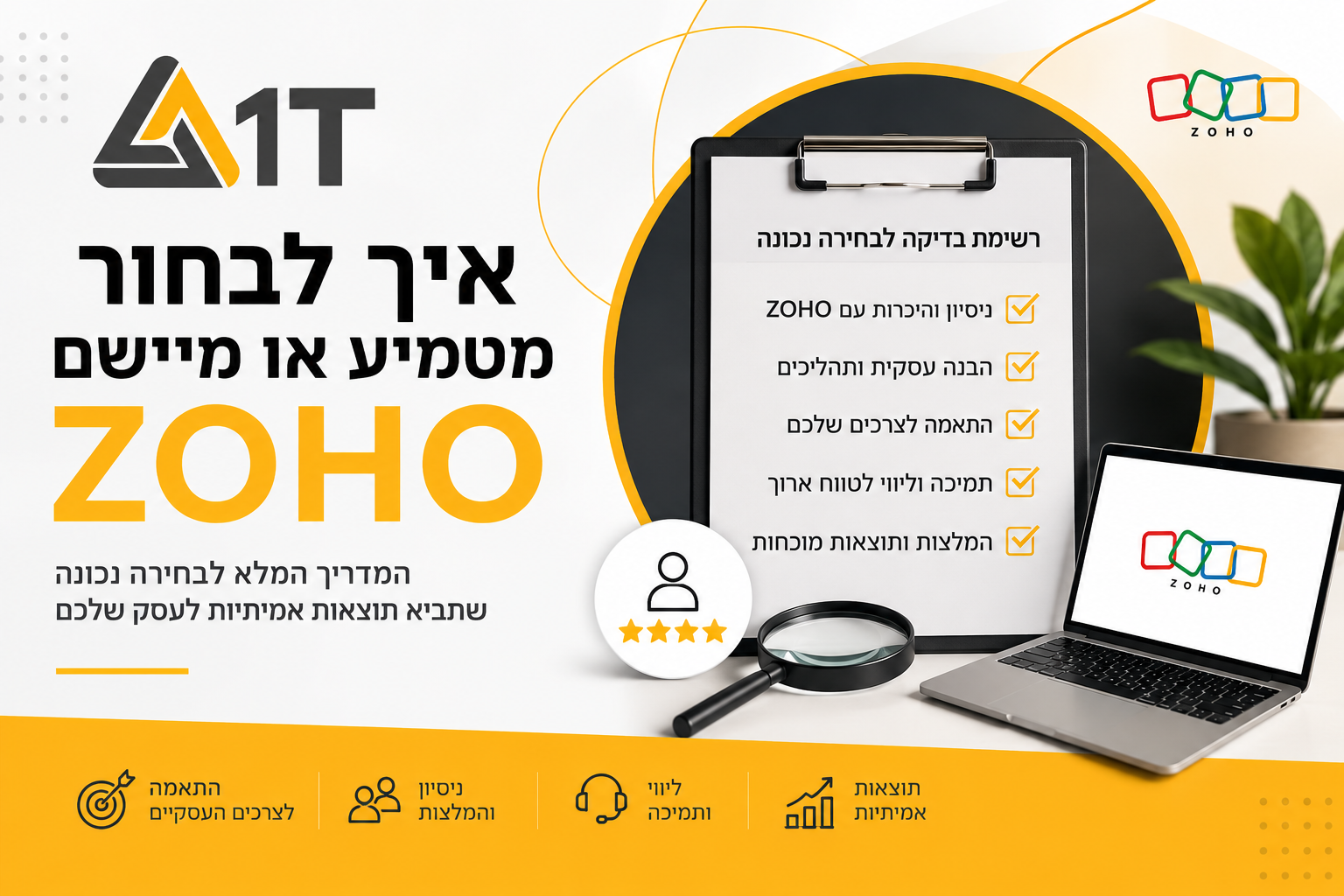
How to choose an implementer or implementer for the Zoho system in Israel? The complete guide

What to look for, what to ask and what a successful Zoho implementation process looks like from the characterization stage to the go-live

May 26, 2026
How to choose an implementer or implementer for the Zoho system in Israel? The complete guide

Key Takeaways

  • 1An orderly and transparent methodology is the most critical factor in choosing a Zoho implementer — neither the price nor the authority.
  • 2A quality implementer understands not only the technology but also the sales processes - and will know how to point out gaps you didn't know you had.
  • 3Any product obtained at the end of each stage is fully owned by you - you can stop the project at any point.
  • 4A detailed characterization document with flow charts and automations is the 'architectural plan' - without this it is impossible to assess the quality of the implementer.

You have decided that you need Zoho CRM — now comes the most critical step: how do you choose a quality implementer? It is likely that you will interview several implementers, compare prices and solutions. To put things in order, we have summarized here our working method at 1T Solutions - what happens at each stage, what is our responsibility and yours, and how together we arrive at an application that brings measurable and real value to the business.

Why the way of working is the main factor in choosing an implementer

An orderly and transparent methodology is the only way to ensure a successful implementation project of a complex business system. You are not CRM experts - therefore it is appropriate that the service provider knows how to reflect the process clearly, flood the necessary questions and make sure that the product matches your expectations. Three things you must know before signing a contract:

  • What will happen at each stage, in what order and what are the schedules - no surprises.
  • How can you evaluate the quality of the work according to the products that will be presented to you.
  • How to avoid deviations in the schedule or budget - and what happens if they occur.

Phase A - introduction and mapping of needs

In the first stage, the goal is to align. The implementer gets to know you, deeply understands the challenges the business faces, and maps the existing business processes - and those that are missing. The products of the step:

  • A detailed quotation document that defines a schedule and budget for the next phase.
  • Defining the 'owner' of the project from your side - the decision maker who leads the process.
  • Appointment of key users from the team to accompany the implementation and perform tests.
  • Defining key KPIs for the success of the project.

Step B - characterization of the system (your architectural plan)

The characterization phase is an iron condition for a successful project - the equivalent of an architectural plan before building a building. The team of experts investigates together with you the functional needs, analyzes how the business operates today and how it should be operated tomorrow. A quality implementer will point out gaps and offer alternatives - not just build what you asked for. The products of the step:

  • In-depth interviews with the key users to understand the required functionality.
  • A detailed characterization document that includes flow charts, field definition, validation rules and required automations.
  • Integration strategy mapping - connecting third party systems and how to connect them.
  • Defining the exact licensing - for existing needs and future growth.
  • Submitting a modular schedule and budget for actual implementation.

Phase C - implementation, automation and internal tests

After the approval of the characterization document, they begin to 'build the house'. At this stage technology meets planning:

  • The establishment of the CRM environment and its exact adaptation to the characterization document.
  • Building information fields, modules, defining user permissions and importing data.
  • Development of business automations, connecting API interfaces, reports and dashboards.
  • Performing a series of internal QA tests to verify that the system is stable and meets all requirements.

Stage D - take-off and acceptance tests

This is the moment of truth — the system is transferred to your team. Now the onus is on you to make sure it does exactly what was promised. Recommendations for effective acceptance tests:

  • Set aside a specified time in the calendar for the key users to perform the tests.
  • Work closely with the characterization document - put a V on each section, process and screen.
  • Prepare daily use scripts and test them (creating a lead, converting to a deal, generating a quote).
  • Submit a concentration of required corrections - the implementer will correct and submit for re-examination until your final approval.

Conclusion

At 1T Solutions we work according to a defined, transparent and modular process - with a detailed characterization document, defined KPIs and fixed pricing that you know in advance. Contact us for a free initial introductory and characterization call.

#Implements Zoho CRM#CRM implementation#Zoho Israel#system characterization#CRM project#small and medium businesses#Zoho Consultant

Want to turn this knowledge into a system that works?

At 1T Solutions we design and implement systems that connect your business, team and technology.

Frequently Asked Questions

An Authorized Partner has passed Zoho training and exams and has access to support and resources directly from Zoho. An independent consultant may be very experienced but without the same support track. The recommendation: check how many implementations were actually carried out in the last year and ask for recommendations - these are more important than authority alone.

A standard project — characterization, implementation, training and go-live — usually lasts 4-10 weeks, depending on the complexity of the integrations and the volume of data. Projects with migration from an existing system or multiple integrations may take 10–16 weeks. Any deviation indicates a problem with the design.

A professional characterization document includes at least: flow charts of sales processes, definition of information fields in each module, validation rules, required automations, lead conversion mapping, definition of access privileges, and a modular schedule for implementation. A document missing one of these is a red flag.

The cheapest implementer often works without a detailed characterization document - which leads to a project that does not meet expectations, to requirements for changes that were not in the original agreement, and sometimes to repeated implementation. Gartner research shows that a failed CRM costs $12,500 per user per year. The $2,000 difference in implement cost is negligible relative to this risk.

In a well-defined modular project, each phase ends with a specific product approved by you. If the product does not meet expectations, approval can be rejected and corrections requested. At the end of each step, all the work materials produced are yours - including the characterization document - even if you decided to change the implementer.

The role of the client is just as critical as the role of the implementer. Required: appointment of a 'owner' of the project on your part, availability of key users for interviews and tests, approval of products at the end of each phase, and a specified time for performing acceptance tests. Projects that fail often fail because of low commitment on the part of the client — not because of the implementer.

Acceptance tests end successfully when each section of the characterization document received a V from the team — scenario after scenario. Recommended process: prepare a list of daily usage scenarios (lead creation, conversion, sending a quote, report creation), go through them one by one and document the findings. Only after all the scenarios have passed - they sign an acceptance.

Interested in more details?

Talk With Us!